
TWIN NAVAUX Project at the Portuguese Naval School

On 5 and 6 March 2024, the IDEIA 2024 conference, promoted by the Portuguese Navy, took place at the Naval Academy of the Lisbon Naval Base.
There, Fátima Leal and Sónia Rolland, from the “Research in Economics, Management and Information Technologies (REMIT)” area of the Universidade Portucalense Infante Dom Henrique (Porto), presented the TWIN NAVAUX project under the title “The use of Digital Twins as a driver of innovation and economic development in the naval auxiliary industry”.
They explained how Digital Twins are virtual models designed to reflect physical objects accurately and can help an organization simulate real situations and their outcomes, which will ultimately enable it to make better decisions.
The Digital Twin supports the design, construction, mission and maintenance phases of the ship.
The economic impact of using product digital twins includes:
- Cost reduction: it allows processes, products and systems to be simulated and optimized in a virtual environment.
- Improved efficiency: it helps companies to identify inefficiencies and optimization opportunities.
- Improved quality: it allows the quality of products and processes to be monitored and controlled more effectively.
- Predictive maintenance: it can predict when maintenance will be needed, in a customized way, for each individual piece of equipment.
- Innovative products and services: it facilitates experimentation and innovation by providing a platform to test new ideas and technologies in a risk-free environment.
- Optimized supply chains: modelling and simulation of supply chain operations, enabling organizations to optimize inventory levels, logistics routes and production plans.
- Data capture and study: digital twins generate large amounts of data that can be analysed and studied for various purposes.
These benefits arise not only in shipbuilding companies, but also in entities such as the Portuguese Navy, which operate and maintain these products throughout their service life.
Publication of the TWIN NAVAUX project Technology Reports on Digital Twin, Augmented Reality and Metaverse
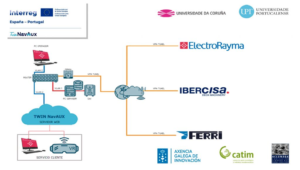
The state-of-the-art reports on various technologies within the TWIN NAVAUX project have been published.
The TWIN NAVAUX project, co-funded by the European Union through the Interreg VI-A Spain-Portugal Programme POCTEP 2021 – 2027, focuses on promoting the use of the Digital Twin in the Naval Auxiliary Industry of Galicia and Northern Portugal, and aims to establish the technological basis and the staff training conditions needed to facilitate the large-scale implementation of product digital twins, both in the naval sector and in other productive sectors of the Euroregion.
The project partners are: – The Xunta de Galicia – The Asociación Clúster do Naval Gallego (ACLUNAGA) – The University of A Coruña (UDC) – The Centro de Apoio Tecnológico à Indústria Metalomecânica (CATIM) – The Universidade Portucalense Infante Dom Henrique – Ibercisa Deck Machinery SA – Industrias Ferri SA – Electrorayma
The following reports have been produced:
- – Report on the situation of the Galicia-Northern Portugal naval sector in the Implementation of Digital Twin enabling technologies.
- – Analysis of the State of the Art of technologies related to the Digital Twin.
- – Report on the State of the Art of Augmented and Virtual Reality and the Metaverse.
You can access these reports at the following link: TWIN NAVAUX Reports
The TWIN NAVAUX project, co-funded by the European Union through the Interreg VI-A Spain-Portugal Programme POCTEP 2021 – 2027, focuses on promoting the use of the **Digital Twin **in the Naval Auxiliary Industry of Galicia and Northern Portugal.
Its objective is to establish the technological basis and the staff training conditions needed to facilitate the large-scale implementation of product digital twins, both in the naval sector and in other productive sectors of the Euroregion.
**
**
The activities
To achieve this objective, the following activities will be carried out:
A.1 Identification of the technological capabilities required for the development of a digital twin in the naval auxiliary sector. A.2 Training of the sector in the transition to the digital twin model. A.3 Roadmap for the implementation of the digital twin in auxiliary companies of the naval sector. A.4 Design and launch of production digital twin pilots in naval auxiliary companies.
The consortium
It is made up of the following entities from Galicia and Portugal
BP – The Axencia Galega de Innovación of the Xunta de Galicia (GAIN) BE2 – The Asociación Clúster do Naval Gallego (ACLUNAGA) BE3 – The University of A Coruña (UDC) BE4 – The Centro de Apoio Tecnológico à Indústria Metalomecânica (CATIM) BE5 – The Universidade Portucalense Infante Dom Henrique BE6 – Ibercisa Deck Machinery SA BE7 – Industrias Ferri SA BE8 – Electrorayma
Funding
The TWIN NAVAUX project has a budget of €1,386,666.38, of which €1,039,999.79 is contributed by the European Regional Development Fund – FEDER, and the rest by the consortium partners.
Project duration
The project begins in September 2023 and ends in December 2025.